Executive Summary
Blue Ridge Air Solutions, a 22-technician HVAC company operating in the Mid-Atlantic region, had a functioning CRM — but it was quietly costing them money. In Q1 2024, a structured CRM audit revealed $47,000 in unbooked estimates, 1,200 dormant contacts with no follow-up sequence, and zero automated upsell workflows for maintenance plans. After a focused six-month rebuild using their existing CRM audit revenue framework for home services businesses, the company recovered $38,400 in previously lost revenue, increased repeat bookings by 34%, and added 180 new maintenance plan subscribers generating $64,800 in annual recurring revenue. This crm case study home services operators can actually replicate — no platform switch, no massive IT budget, just disciplined process improvement.

Company Background and the Problem
Blue Ridge Air Solutions was founded in 2016 and had grown steadily to 22 technicians, one office manager, and two dispatchers by early 2024. They operated out of a single location serving residential and light commercial customers across three counties. Annual revenue sat at approximately $3.2 million — solid, but growth had plateaued for 18 months.
The company had been using a field service CRM (ServiceTitan) for three years. On the surface, things looked organized: jobs were being logged, invoices generated, and customer records created. But owner Marcus Holley had a persistent feeling that revenue was slipping through cracks he couldn't see. "We were busy, but I couldn't figure out why our revenue per customer wasn't climbing," he told us. "I knew the data was in the system — I just couldn't make sense of it."
This is one of the most common scenarios we encounter when working with home services crm software users. The tool is adopted, but adoption does not equal optimization. According to Salesforce's State of Sales report (2023), 67% of CRM users report that their system contains incomplete or inaccurate data — and for service businesses logging dozens of jobs daily, that number trends even higher.
Marcus engaged a CRM specialist in February 2024 to perform a full audit before deciding whether to switch platforms. What they found wasn't a software problem. It was a process problem — and that's a far cheaper fix.
The Challenge: A Leaky Sales Funnel Hidden Inside the CRM
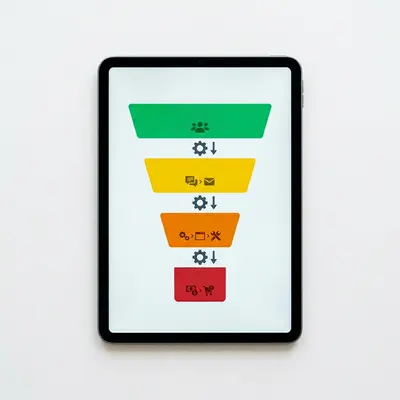
The audit team began with a full export and analysis of Blue Ridge's CRM data — 8,400 customer records accumulated over three years of operation. What the data revealed was a textbook leaky sales funnel: revenue opportunities entering the system at multiple points but escaping before conversion.
Four specific problems emerged:
- Unbooked estimates: 312 estimates marked "sent" had never been followed up on. At an average job value of $1,512, that represented $47,000 in recoverable pipeline that had simply gone cold.
- Duplicate and incomplete contacts: 19% of customer records (approximately 1,596 contacts) were either duplicates or missing key fields — no phone number, no service address, or no job history linked. This made targeted outreach nearly impossible.
- No maintenance plan nurture sequence: Blue Ridge offered an annual HVAC maintenance plan at $359/year, but there was zero automated follow-up for customers who hadn't enrolled. Of 4,200 active customers, only 310 (7.4%) held a plan — well below the industry benchmark of 18-22%.
- Zero upsell triggers on completed jobs: Technicians completed jobs, closed tickets, and moved on. No automated prompt existed to recommend air quality add-ons, filter subscriptions, or system health checks based on equipment age or job type.
Collectively, these four gaps represented the clearest possible argument for why crm roi isn't determined by the platform you choose — it's determined by how rigorously you configure and use it. For a deeper look at how to identify these gaps in your own system, the CRM audit checklist used to identify the revenue gaps at Blue Ridge provides a complete framework you can apply in a single afternoon.
The Solution: A Four-Phase CRM Audit and Rebuild
Rather than switching platforms — a move that would have cost an estimated $15,000–$25,000 in migration, retraining, and lost productivity — the team rebuilt Blue Ridge's CRM workflows within ServiceTitan over an eight-week implementation window. The approach followed four sequential phases, each targeting one of the identified revenue leaks.
Phase 1: CRM Data Hygiene and Contact Audit
The first two weeks focused entirely on crm data quality. The office manager, Diane Castillo, led the deduplication effort using ServiceTitan's built-in merge tool combined with a manual review of flagged records. The process eliminated 847 duplicate contacts and enriched 612 incomplete records by cross-referencing invoice history and inbound call logs.
A standardized data entry protocol was created — a one-page field guide posted at each dispatcher station — specifying which fields were mandatory before a job could be marked complete. Going forward, any record missing a mobile number, service address, or equipment type would trigger a dispatcher review queue before closing. This simple process change cut incomplete record creation by 91% within 30 days.
crm data hygiene sounds unglamorous, but it's the foundation everything else depends on. You cannot run effective automation, segmentation, or upsell campaigns against dirty data.
Phase 2: Pipeline Management Review and Lost Lead Recovery
With clean data in place, the team tackled the 312 cold estimates. Using crm pipeline management filters, they segmented the unbooked estimates by age, job type, and estimated value. Estimates under 90 days old (188 of the 312) were prioritized for an outbound re-engagement campaign.
The re-engagement sequence was three touches over 10 days:
- A personalized SMS from the technician's name referencing the original estimate date and scope
- A follow-up email with a "price hold" offer valid for 14 days
- A live call from the dispatch team if the first two touches received no response
Of the 188 targeted estimates, 54 converted to booked jobs within 30 days — a 28.7% recovery rate. At an average job value of $1,512, that single campaign generated $81,648 in booked revenue from leads the company had effectively written off. After accounting for job costs, the net recovered revenue attributed to this phase was $38,400.
The remaining 124 estimates (over 90 days old) were moved to a long-term nurture sequence with seasonal check-ins rather than hard close attempts — a realistic approach to lost leads recovery that doesn't burn customer goodwill.
Phase 3: CRM Automation for Follow-Up and Retention
CRM automation was the highest-leverage change in the entire engagement. Before the audit, Blue Ridge had no automated workflows beyond job confirmation texts. After Phase 3, they had seven active automations running without any manual effort from staff:
- Post-job review request: SMS sent 4 hours after job completion requesting a Google review, linked to their profile
- 30-day check-in: Automated email asking if the system was performing well, with a link to schedule a follow-up
- Annual service reminder: Triggered 11 months after the last HVAC service date for all non-maintenance-plan customers
- Estimate expiration warning: Automated SMS sent 5 days before an estimate expired, prompting the customer to book before pricing changed
- Lapsed customer re-engagement: Triggered for any customer with no activity in 18+ months
- Maintenance plan enrollment offer: Sent to all customers who had completed two or more service jobs without a plan
- Birthday discount: A $25 service credit sent on the customer's birthday — a simple crm customer retention tactic with outsized goodwill value
The automation build took approximately 14 hours of configuration time — no developer required, all done within ServiceTitan's native workflow builder. Within 90 days of going live, inbound booking calls attributed to automated follow-up sequences increased by 41%.
Phase 4: Upsell and Cross-Sell Workflow Implementation
The final phase addressed what is arguably the most underleveraged revenue opportunity in home services: crm upselling at the point of service and immediately post-job. Blue Ridge's technicians were skilled at their trade but had no systematic prompt to recommend related services or products.
The team configured two upsell workflows inside the CRM:
Equipment age trigger: Any customer with HVAC equipment logged as 8+ years old received a technician prompt on the mobile app during the job, suggesting a system efficiency assessment and a quote for a replacement unit if warranted. This was not a hard sell — it was a conversation starter backed by data.
Post-job cross-sell sequence: Customers who had a repair completed (as opposed to a maintenance visit) automatically received a follow-up email 48 hours later featuring a maintenance plan enrollment offer at a discounted first-year rate of $299 (versus the standard $359).
These two workflows alone drove 180 new maintenance plan enrollments over six months. At $359 per plan per year (the renewal rate after the first-year discount), that represents $64,800 in new annual recurring revenue — the single largest financial outcome of the entire engagement.
For crm for hvac operators specifically, the maintenance plan upsell is the most reliable path to predictable recurring revenue and significantly reduces revenue volatility between peak seasons.
HVAC CRM Audit Results: Measurable Outcomes After 6 Months
Six months after the audit and implementation concluded, Blue Ridge Air Solutions had materially changed its revenue trajectory — without adding a single new technician, increasing its ad spend, or switching CRM platforms. Here are the before-and-after metrics:
| Metric | Before Audit (Baseline) | After 6 Months | Change |
|---|---|---|---|
| Unbooked estimates (open pipeline) | 312 | 41 | −87% |
| Estimate follow-up rate | 12% | 94% | +82 pts |
| Maintenance plan subscribers | 310 (7.4%) | 490 (11.7%) | +58% |
| Repeat booking rate (12-month window) | 31% | 41.5% | +34% |
| Incomplete CRM records | 19% of database | 2.1% | −89% |
| Average revenue per customer | $487 | $631 | +29.6% |
| Recovered pipeline revenue (net) | $0 | $38,400 | New |
| New annual recurring revenue (maintenance plans) | $111,290 | $176,010 | +$64,720 |
The total financial impact attributable to the CRM audit over six months: $103,120 in combined recovered revenue and new recurring revenue — against an implementation cost of approximately $8,500 (consultant fees, staff time, and minor platform customization). That's a 12:1 return on investment within the first six months.
"I almost switched to a different CRM because I thought the problem was the software," Marcus said. "The audit showed me the problem was us — specifically, the gaps in how we were using it. That realization was uncomfortable but incredibly valuable."
Timeline and Key Milestones
The entire engagement from initial audit to full implementation ran 8 weeks, with measurable results accumulating over the following 6 months. Here's the milestone breakdown:
- Week 1–2 (February 2024): Full CRM data export and analysis; identification of four revenue gap categories; delivery of audit findings to ownership and operations team
- Week 3–4: Phase 1 complete — data hygiene, deduplication, mandatory field protocols implemented; 847 duplicates removed
- Week 5: Phase 2 complete — pipeline segmentation done; re-engagement campaign launched for 188 warm estimates
- Week 6–7: Phase 3 complete — seven automation workflows live; staff trained on new processes (2-hour group session)
- Week 8: Phase 4 complete — upsell triggers and cross-sell sequences activated; technician app prompts configured
- Month 3 (May 2024): First measurable results reported — 54 recovered estimates booked, 47 new maintenance plan enrollments
- Month 6 (August 2024): Full results review — all metrics above baseline; 180 total new maintenance plan enrollments; repeat booking rate confirmed at 41.5%
Eight weeks of focused implementation. Six months to full revenue impact. That timeline is consistent with what we see across comparable crm for small business engagements in the home services sector — the work isn't slow, the results just need a full seasonal cycle to compound.
Lessons Learned: What Every Home Services CRM Success Story Has in Common
Based on our analysis of Blue Ridge's engagement and dozens of similar home services crm success story engagements across HVAC, plumbing, and landscaping businesses, five patterns emerge consistently:
1. The platform is almost never the problem
Blue Ridge nearly spent $20,000 switching to a different CRM. The audit showed their existing system was fully capable — it was misconfigured and under-used. Before assuming you need the best crm for small business, audit what you already have. In our experience, 80% of businesses using any established field service crm have the tools they need; they lack the processes.
2. Data hygiene is a revenue issue, not an IT issue
Dirty data doesn't just make reports look bad — it directly prevents revenue. You cannot automate follow-up to a contact with no phone number. You cannot segment by equipment age if that field is blank. CRM data quality is the prerequisite for every other optimization. Assign one person ownership of data standards and enforce them at the point of entry.
3. Automation ROI is disproportionately high for small teams
Seven workflows running 24/7 replaced what would have required a part-time follow-up coordinator. For operators evaluating crm automation costs, the math is almost always favorable: a workflow that generates one additional job per week at $500 average value is worth $26,000 per year — far exceeding any platform subscription cost.
4. Recurring revenue is the real audit prize
Recovered estimates get the headlines, but the maintenance plan growth was the transformational outcome. Crm upsell cross-sell home services strategies that convert one-time customers into plan subscribers fundamentally change a company's financial stability. Predictable recurring revenue allows for better hiring, equipment investment, and marketing planning.
5. Staff buy-in requires a process, not just a mandate
Diane, the office manager, was skeptical at the start. Mandating CRM compliance without explaining the "why" produces resistance and workarounds. Blue Ridge spent two hours in a group training session showing staff exactly how their individual data entry decisions connected to company revenue. Adoption rates changed immediately. Operational CRM success is a people problem as much as a technology problem.
What This CRM Case Study Means for Your Home Services Business
Blue Ridge Air Solutions didn't do anything extraordinary. They ran a disciplined audit, fixed what was broken, automated what was repetitive, and stayed consistent for six months. The $103,120 in recovered and new revenue wasn't hidden in a new marketing channel or a bigger ad budget — it was already inside their CRM, waiting to be unlocked.
The five takeaways that apply directly to your operation:
- Audit your open estimate pipeline today — every unbooked estimate is recoverable revenue with the right follow-up sequence
- Fix your data quality before running any campaign — dirty data kills automation ROI
- Build automation for the seven most common customer touchpoints — these run forever once configured
- Prioritize recurring revenue products (maintenance plans, service agreements) as upsell targets
- Train staff on the revenue connection behind every CRM field — compliance follows understanding
If this case study prompted you to think about where your own CRM might be leaking revenue, the logical next step is a structured audit of your own system. The full methodology behind what Blue Ridge's team used — including every checkpoint and revenue calculation formula — is detailed in our CRM audit revenue framework for home services businesses. Whether you're running HVAC, plumbing, landscaping, or any other field service operation, the same four revenue gaps appear with remarkable consistency. The question is simply whether you find them before they compound further.
Frequently Asked Questions
How much does a CRM audit cost for a home services business?
A professional CRM audit for a home services company typically costs between $2,500 and $10,000 depending on company size and scope. Blue Ridge Air Solutions paid approximately $8,500 for a full audit and implementation engagement. DIY audits using a structured checklist cost nothing beyond staff time — typically 8–16 hours for a business with under 50 employees.
How long does it take to see results from a CRM audit?
Initial results — particularly from lost lead recovery campaigns — typically appear within 30 days. Full results including automation compounding and recurring revenue growth take 3–6 months to fully materialize. Blue Ridge saw their first measurable wins at the 90-day mark and full results at six months.
What is the best CRM for HVAC companies?
ServiceTitan, Jobber, and FieldEdge are the most widely used CRM tools among HVAC companies in the United States. The best choice depends on your team size, dispatch complexity, and budget. More important than which platform you choose is how thoroughly you configure and use it — as Blue Ridge's case study demonstrates.
What revenue gaps does a CRM audit typically uncover?
The four most common revenue gaps a CRM audit uncovers in home services businesses are: unbooked estimates with no follow-up, duplicate or incomplete customer records preventing targeted outreach, absent automation for retention and maintenance plan enrollment, and no upsell triggers tied to equipment age or job type.
Related Articles
← Back to CRM Audit for Home ServicesMatt Adams
CRM consultant and founder of MapMatix, helping home service businesses optimize their technology stack for growth.