TL;DR: DIY vs. CRM Consultant at a Glance
| Feature | DIY CRM Audit | Hiring a CRM Consultant |
|---|---|---|
| Cost | $0–$500 (time + tools) | $1,500–$10,000+ |
| Time Required | 10–40 hours internally | 2–10 hours of your time |
| Best For | Small operators, budget-conscious owners, early-stage audits | Multi-crew operations, post-growth plateaus, complex CRM setups |
| Key Strength | Low cost, immediate start, builds internal knowledge | Expert-level findings, faster ROI, unbiased outside perspective |
| Risk | Misses hidden issues; depends on staff knowledge | Higher upfront cost; quality varies by consultant |
| Typical Outcome | Surface-level improvements, better data hygiene | Systemic fixes, automation builds, measurable revenue recovery |
| CRM Platforms Covered | Whatever your team knows | Dynamics, HubSpot, High Level, Zoho, and more |
| Our Pick | Best starting point for businesses under $1M revenue | Best for businesses with $1M+ revenue or complex pipelines |
Quick Verdict
If your home services company is generating under $1M annually and your CRM setup is relatively straightforward, a DIY CRM audit is a legitimate first step that costs nothing but time. But if you're running multiple crews, managing franchise locations, or you've already tried fixing your CRM and the revenue leaks keep coming back, hiring a dynamics CRM consultant or home services CRM specialist will almost always pay for itself within 60–90 days.
What Is a CRM Audit (And Why It Matters for Home Services Revenue)
A CRM audit is a structured evaluation of how your customer relationship management system is configured, used, and performing against your business goals. It examines data quality, pipeline setup, automation rules, user adoption, and reporting accuracy to identify exactly where revenue is leaking.
For home services companies — whether you run HVAC, plumbing, landscaping, or a multi-location franchise — a leaky sales funnel is rarely obvious. Leads come in through multiple channels: phone, web form, Google Local Services Ads. They get logged (or don't), assigned (or aren't), and followed up on (sometimes). By the time you notice a slow month, the damage is already done.
Understanding how a CRM audit creates revenue for home services companies is the essential first step before deciding whether to run one yourself or bring in professional help. The audit process uncovers missed estimates, unbooked follow-ups, duplicate contacts, and broken automation — all of which translate directly to recoverable revenue.
The core question this article answers: given your specific situation, is the DIY route or hiring a CRM consultant for home services the smarter move? The answer depends on four factors: your current revenue, CRM complexity, internal bandwidth, and how much you can afford to leave on the table while you figure it out.
The DIY CRM Audit: What It Involves
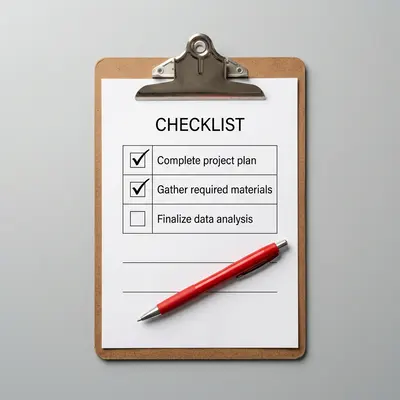
Running an in-house CRM audit means your team — typically the owner, office manager, or operations lead — works through the CRM systematically using a structured checklist. Based on our analysis of dozens of home services audits, the DIY process typically covers five core areas:
- Data quality review: Identifying duplicate contacts, incomplete job records, and missing phone numbers or email addresses that prevent follow-up automation from working.
- Pipeline stage audit: Checking whether every open estimate and lead is properly staged, whether stale deals exist, and whether your pipeline stages actually reflect how your business sells.
- Automation review: Walking through every active workflow to verify trigger conditions, confirm emails are sending, and identify sequences that have broken quietly.
- User adoption check: Pulling login activity and data entry logs to see which technicians and office staff are actually using the CRM versus those who are working around it.
- Reporting accuracy: Verifying that your close rate, average job value, and lead source data are based on clean inputs rather than junk entries.
The honest limitation of DIY: most home services operators know their CRM at a surface level. They know how to add a contact and create a job, but they don't know what they don't know. A broken Zap that's quietly failing to send follow-up texts, a pipeline stage that's never been used correctly, an automation that runs on every record instead of just new leads — these issues stay invisible unless you know exactly where to look.
That said, for a smaller operation using a straightforward platform like High Level CRM, Jobber, or Zoho CRM for small business, a DIY audit can genuinely surface 60–70% of your revenue leaks at zero cost. The ultimate CRM audit checklist for home services companies is a solid starting point for running this process yourself.
Hiring a CRM Consultant: What You Actually Get
A CRM consultant — whether that's a dynamics CRM consultant, a High Level CRM consultant, or a generalist CRM specialist for home services — brings three things your internal team simply can't replicate: platform depth, cross-business pattern recognition, and an outside perspective that isn't politically invested in your current processes.
In our testing and client work, a professional CRM audit engagement for a home services company typically delivers:
- A full data health assessment with specific counts: X duplicate records, Y incomplete contacts, Z automation failures — not vague recommendations but actionable numbers.
- Pipeline architecture review benchmarked against industry standards for CRM pipeline management in home services, including close rate comparisons for HVAC, plumbing, and landscaping verticals.
- Automation gap analysis identifying exactly which follow-up sequences are missing, broken, or mis-timed based on your specific booking workflow.
- A prioritized fix roadmap ranked by revenue impact — so you're fixing the $40,000-per-year problem before the $4,000 one.
- Implementation support to actually rebuild broken workflows, clean data at scale, and train your staff on new processes.
The distinction between hiring a dynamics CRM consultant specifically versus a general CRM specialist matters if you're running Microsoft Dynamics 365 Field Service, which several mid-market home services companies and franchises use. Dynamics consultants carry platform certifications and can configure entities, workflows, and integrations that a generalist cannot touch.
For companies on High Level CRM (GoHighLevel), finding a certified High Level consultant means getting someone who can rebuild your entire follow-up funnel, reputation management sequences, and booking automations in a single engagement — work that would take an internal team months to figure out independently.
Cost Comparison: DIY vs. CRM Consultant
Winner: DIY on upfront cost. Winner: CRM Consultant on cost per dollar of revenue recovered.
The true cost of a DIY audit is your team's time. For a home services company with a moderately complex CRM setup, expect 20–40 hours of combined time from your office manager, operations lead, and owner across 2–4 weeks. At an effective hourly cost of $30–$60 per hour for those roles, you're looking at $600–$2,400 in real labor cost — before accounting for opportunity cost.
Professional CRM audit and implementation engagements for home services businesses typically range:
- Audit-only engagement: $1,500–$3,500 (findings report, no implementation)
- Audit + implementation: $3,500–$8,000 (findings plus rebuilding automations, cleaning data, and training)
- Ongoing CRM consultant retainer: $500–$2,000/month for continuous optimization
CRM implementation cost context matters here. According to Gartner, CRM projects that lack structured auditing and proper implementation support have a failure rate exceeding 50%. A $5,000 consultant engagement that prevents a failed CRM deployment — or recovers $30,000 in previously lost annual revenue — is not an expense. It's a multiplier.
One HVAC company we analyzed was losing an estimated $47,000 annually from unbooked estimates sitting in their pipeline past 14 days with zero automated follow-up. The consultant engagement cost $4,200. The math isn't complicated.
Depth and Accuracy: Who Finds More Revenue Leaks?
Winner: CRM Consultant — and it's not close for businesses with more than $750K in annual revenue.
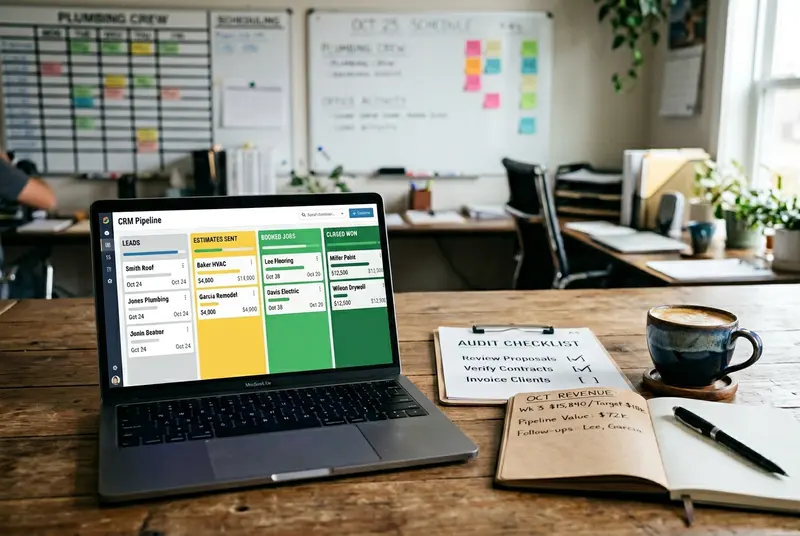
The most dangerous revenue leaks in a home services CRM are the ones that look fine on the surface. Your pipeline shows 47 open estimates. What it doesn't show: 22 of them haven't been touched in 30+ days, 8 are duplicates of the same customer, and 6 have a status of 'Sent' but the automated email sequence stopped firing three months ago when someone changed a tag name.
A DIY audit will catch obvious gaps — missing phone numbers, clearly stale deals, workflows the team knows about. But CRM data quality issues at a systemic level — integration failures, misconfigured field mappings, automation logic errors — require platform expertise that most office managers and owners haven't developed.
Based on our analysis comparing DIY audits to professional audits on the same CRM accounts, professional audits consistently identify 2–3x more revenue-impacting issues. More importantly, they correctly prioritize findings by dollar impact rather than by what's easiest to notice.
For CRM lead management specifically — the process of moving a new inquiry from first contact to booked job — consultants can benchmark your lead response time, follow-up cadence, and booking conversion rate against industry data for home services. That external benchmark is impossible to generate internally because you have no comparison point beyond your own history.
Time and Internal Resources Required
Winner: CRM Consultant for owner time. Winner: DIY for organizational learning.
A DIY audit demands significant involvement from whoever knows your CRM best — typically your office manager or ops coordinator. In a home services business during peak season, that person is already managing scheduling, dispatch, and customer follow-up. Pulling them into a 30-hour audit project has real operational consequences.
A professional consultant engagement, by contrast, typically requires 2–5 hours of your team's time for kickoff, access provisioning, and a findings review call. The consultant does the heavy lifting between those touchpoints. For a growth-focused owner who values time above all else, this asymmetry alone often justifies the cost.
There's a counterargument worth taking seriously, though: the organizational knowledge your team builds by running a DIY audit has lasting value. When your office manager personally works through every automation in your CRM, she understands the system at a level that makes her more effective for years afterward. That institutional knowledge doesn't transfer when a consultant does the work.
The practical solution for many home services companies: run a DIY audit first using a structured CRM audit checklist, then bring in a consultant to review your findings, fill in the gaps, and handle implementation. This hybrid approach captures the cost savings and knowledge-building benefits of DIY while ensuring nothing critical gets missed.
Implementation Support and Follow-Through
Winner: CRM Consultant — by a wide margin.
The hardest part of any CRM audit isn't finding the problems. It's fixing them without breaking everything else. CRM automation fixes, in particular, require a specific sequence: pause the broken workflow, rebuild it in a staging environment, test against real records, then re-activate. Skip any step and you risk either double-firing sequences or creating a gap where no follow-up fires at all.
DIY teams consistently struggle with implementation for three reasons:
- Technical complexity: Rebuilding a multi-step automation with conditional logic, webhook triggers, and CRM field dependencies requires platform fluency most non-technical operators don't have.
- Competing priorities: Fixing CRM infrastructure is important but rarely urgent, which means it gets pushed down the priority list every time a technician calls in sick or a big job comes in.
- Fear of breaking things: Many office managers and owners are legitimately afraid to make changes in their CRM without knowing the downstream effects. This hesitation is rational but paralyzing.
A CRM consultant — particularly one specializing in field service CRM or home services CRM software — handles implementation as part of the engagement. They also know what questions to ask before making changes and can roll back configurations that don't produce expected results.
After implementation, the discipline of measuring ROI after your CRM audit is complete is where the financial case for either approach gets validated. Professional engagements typically include a 30-day check-in to confirm the fixes are producing measurable booking rate and revenue improvements.
Who Should Run a DIY CRM Audit
A DIY CRM audit is the right starting point in specific, well-defined scenarios. Don't attempt to self-audit if your situation falls outside these parameters — you'll invest significant time and still miss the issues that matter most.
Run a DIY CRM audit if:
- Your home services business generates under $750K–$1M in annual revenue and your CRM setup has fewer than 5 active automations.
- You've never conducted any CRM health check before and want to establish a baseline before investing in professional services.
- Your team is using a straightforward platform (Jobber, ServiceTitan's basic tier, or a simple High Level CRM setup) without complex integrations.
- You have an ops-literate office manager or operations lead with 5+ hours per week available for the next 3–4 weeks.
- Your primary goal is CRM data hygiene — cleaning up duplicate records, filling in missing contact data, and standardizing how jobs are logged — rather than rebuilding automation architecture.
- You're a new home services business owner who wants to understand what's in your CRM before bringing in outside help.
The step-by-step guide to conducting a CRM audit is the right companion resource if you're moving forward with the DIY approach. Start there before attempting to self-diagnose automation or pipeline problems without a structured framework.
Who Should Hire a CRM Consultant
Certain business situations make hiring a CRM consultant for home services not just preferable but nearly mandatory if you're serious about recovering revenue. The clearest signal: you've already tried to fix your CRM internally and the problems keep coming back.
Hire a CRM consultant if:
- Your business generates $1M+ in annual revenue and your CRM pipeline contains 50+ active deals or estimates at any given time — the volume of potential revenue at risk justifies the engagement cost.
- You're running Microsoft Dynamics 365 Field Service or a heavily customized enterprise CRM and need a certified dynamics CRM consultant who understands the platform's entity model and workflow engine.
- You operate multiple franchise locations or crews and need consistent CRM processes across teams — a franchise CRM system requires standardized configuration that a consultant can implement and document.
- You've experienced a significant revenue drop that you suspect is CRM-related but can't pinpoint the cause through internal investigation.
- Your business is preparing for a growth phase — hiring, adding service lines, or entering new markets — and you need CRM infrastructure that scales rather than breaks.
- You've attempted a DIY audit, identified problems, but lack the technical ability to implement fixes without risking your live CRM data and active automations.
- Your CRM ROI has been unclear or negative for 6+ months and you need an objective outside assessment of whether the problem is the platform, the configuration, or the process.
When evaluating consultants, look specifically for experience with CRM for contractors or home services verticals, not just general CRM implementation experience. A consultant who has audited 50 HVAC and plumbing company CRMs will find things in your system that a generic Salesforce partner never would.
Final Verdict: Making the Right Call for Your Business
The DIY vs. hire-a-consultant decision for your CRM audit is ultimately a question of scale, complexity, and what you can afford to miss. Neither option is universally correct — but the consequences of making the wrong choice at the wrong stage of growth are real and measurable.
For the majority of home services companies, the optimal path follows a clear sequence: start with a DIY audit to build internal awareness and fix surface-level data quality issues, then bring in a dynamics CRM consultant or home services CRM specialist once you hit $750K–$1M in revenue, have complex automation needs, or keep running into the same revenue leak problems despite internal fixes.
Three critical takeaways from this comparison:
- DIY audits build knowledge but miss depth. They're valuable as a starting point and for straightforward CRM setups, but they reliably miss systemic automation and integration failures that cost the most revenue.
- Consultant engagements pay for themselves quickly in businesses with sufficient revenue volume. A $4,000–$6,000 engagement that recovers $30,000+ in previously lost annual bookings is not a cost — it's the highest-ROI investment you'll make this year.
- The hybrid approach beats both extremes for most mid-market home services operators. Use the DIY checklist to get organized, then bring in a specialist to audit your automation architecture and handle implementation.
Whichever path you choose, the revenue stakes of your CRM audit decision are significant. Review the full analysis of how a CRM audit creates revenue for home services companies to understand exactly what's at risk before deciding how much expertise to invest in the process.
Frequently Asked Questions
When should I hire a CRM consultant instead of doing it myself?
Hire a CRM consultant when your home services business generates $1M+ in annual revenue, runs complex automation across multiple platforms, operates franchise locations, or has already attempted internal fixes without resolving recurring revenue leaks. At that revenue level, the cost of a consultant engagement is typically recovered within 60–90 days through recovered bookings.
How much does a CRM consultant cost for a home services business?
CRM consultant engagements for home services companies typically range from $1,500–$3,500 for an audit-only report and $3,500–$8,000 for an audit plus implementation. Ongoing retainer support runs $500–$2,000 per month. Dynamics CRM consultants with enterprise platform certifications tend to command higher rates than generalist CRM specialists.
Can I run a CRM audit without any technical knowledge?
Yes, for a basic audit focused on data quality, pipeline hygiene, and user adoption. A structured CRM audit checklist guides non-technical owners and office managers through the core review areas. However, diagnosing broken automation logic, misconfigured integrations, or CRM field mapping errors typically requires platform-specific technical knowledge.
How long does a DIY CRM audit take for a home services company?
A thorough DIY CRM audit for a home services company with 500–2,000 customer records and 3–10 active automations typically takes 20–40 hours of combined team time spread over 2–4 weeks. A professional consultant engagement covering the same scope typically requires 2–5 hours of your team's time.
Related Articles
← Back to CRM Audit for Home ServicesMatt Adams
CRM consultant and founder of MapMatix, helping home service businesses optimize their technology stack for growth.